

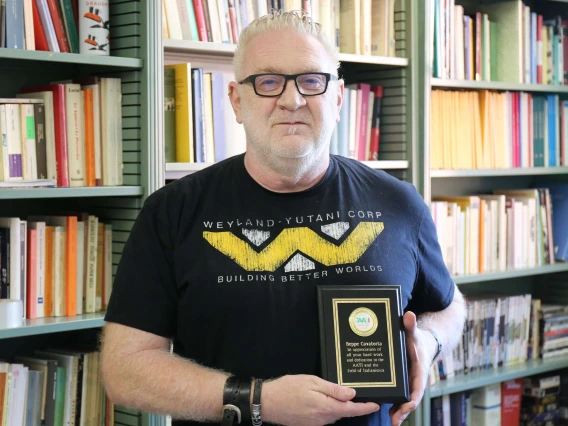
Beppe Cavatorta, a professor of Italian, translator, poet, editor and former president and informal “poet laureate” of the American Association of Teachers of Italian, passed away on Oct. 10. He was 62.
Born in Parma, Italy in 1964, Giuseppe “Beppe” Cavatorta joined the University of Arizona faculty in 2007, with wide-ranging research interests that included experimental writings, Italian futurism and the neo-avant-garde, the Second World War in literature and film, and the theory and practice of translation.
“Beppe was beloved by his students and colleagues. The national and international impact of his scholarly work as well as his world class teaching played a major part in our Italian Studies program being one of the best and largest in North America. He will be greatly missed. On behalf of the College of Humanities, I present our condolences to Beppe’s family, friends, colleagues and students,” said Alain-Philippe Durand, Dorrance Dean of the College of Humanities.
Cavatorta graduated from the University of Parma, then continued his studies in the United States, earning a master’s degree from the University of Virginia and a Ph.D. from the University of California, Los Angeles. He taught at Dartmouth College before joining the U of A faculty.
Carine Bourget, Head of the Department of French and Italian, said she first met Beppe in spring 2007 when he came to Tucson for his campus interview and said “his charismatic teaching appeals to all, from 17-year-old freshmen to 70-year-old lifelong learners.”
“His students’ anonymous comments on teaching evaluations, as well as award nomination letters, testify what a phenomenal educator Beppe was,” she said. “He leaves a profound impact through the thousands of pages he wrote, translated, and edited, and the people he touched professionally and personally.”
A specialist in 20th-century Italian literature, Cavatorta’s publications include Scrivere contro (2010), a study of Italian experimental writing, along with numerous edited volumes, critical essays, and translations. He was a leading authority on the poet Adriano Spatola, whose work he helped bring to English-speaking audiences through The Position of Things: Collected Poems, 1961–1992 (2008). One of his most ambitious achievements is Those Who from Afar Look Like Flies, a monumental anthology of modern Italian poetry co-edited with Luigi Ballerini and published by the University of Toronto Press.
Cavatorta’s colleagues Maria Letizia Bellocchio and Francesco Rabissi wrote in an obituary that “Above all, he was a generous friend, a passionate conversationalist, and a man of remarkable intellectual curiosity, humor, and kindness.”
Cavatorta always remained close to his hometown of Parma, building a life between two countries and keeping his Italian roots while creating a home and a community in Tucson, they wrote. A lifelong soccer enthusiast, he had played goalkeeper for San Lazzaro, his neighborhood team, and never lost his passion for the game. He loved cooking, especially for others, and was a warm and loyal friend.
“As a colleague and mentor, he inspired others through his intellectual generosity, integrity, and kindness,” they wrote. “Beppe’s legacy lives on not only in his publications and the students he taught, but also in the friendships he cultivated, the conversations he inspired, and the countless lives he touched. He will be remembered for his intellect, generosity, humor, and unwavering authenticity, and will be deeply missed by his family, friends, colleagues, and all those fortunate enough to have known him.”
One of Cavatorta’s recent projects was Italian in Wonderland. Along with fellow faculty members Bellocchio and Borbi Gaspar, he received a $150,000 grant from the National Endowment for the Humanities to create an open, online educational platform for lessons in Italian language and culture, making the learning materials freely accessible to students and educators everywhere.
Gaspar said she wished she had Cavatorta's gift with words to express how much he meant as a mentor.
“Beppe embodied everything we love about the humanities. He brought them to life through his actions, quietly recognizing the complexity of people’s lives and helping others see one another, feel seen and heard, and remain connected to the past and present,” she said. “Beppe is no longer here to tell his stories or encourage us to keep our spirits up, but his deeds and words continue to give us hope. They remind us every day of the power of the humanities to connect us, deepen our understanding of one another, and help us imagine and build a better world.”
In 2024, Cavatorta received the Distinguished Service Award from the American Association of Teachers of Italian. He had been president of the organization from 2018 to 2021.
In a tribute posted to the AATI website, the organization’s president M. Marina Melita, Chair of the Department of World Languages and Cultures at Marist University, wrote that “Beppe was a presence unlike any other,” and “the non-conforming poet extraordinaire that so many of us came to know and love.”
“Beppe had a remarkable ability to see what people were capable of, even when they could not yet see it themselves. He was inclusive, accepting, generous, and deeply committed to helping others succeed,” she wrote. “Throughout his distinguished career, Beppe made significant contributions to Italian Studies as a scholar, teacher, translator, editor, poet, and mentor. His work shaped the field in countless ways, and his dedication to Italian language and culture touched generations of students and educators.”
Past AATI president Ryan Calabretta-Sajder, Director of International and Global Studies at the University of Arkansas, wrote that beyond the AATI, Cavatorta was a cornerstone of the AP Italian Program, serving in every role at one point or another, including two terms as chief reader who “understood that behind each student's words was a learner taking a risk in a new language, and he honored that risk.”
“Whether he was carrying a poet’s line from one language into another, tracing the breaks and ruptures of twentieth-century experimental fiction, or setting down verses of his own, Beppe treated every word as something to be weighed, honored, and carried across. In him, the translator, the critic, and the poet were one and the same reader, devoted to the word,” he wrote. “To so many of us, he was and will remain our poet, our captain.”